UCPI Evidence Cleaned and Analysed Blog 1
As of the last the last day of evidence in February 2026 The UCPI Inquiry database contained 8,111 items of evidence. Goodness know how many pages of the documentary items run to, and it does not included the transcripts of the public proceedings many of which are also published.
Of course the proceedings are not all being held completely in public, and most of the documents have been redacted to some degree. There are numerous reasons for the redactions and closed sessions. Some of those reasons are reasonable for example to protect the privacy of civilian witnesses, to offer civilian witnesses some protection from the defamatory and unproven and often patently untrue allegations of of former UCOs. Others including the protection of the reputation of public figures and organisations are spurious. Still others are based on wholly inadequate assessments of the risks posed to public order, the safety of the realm, or faced by individual UCOs in the event of their assumed identity being disclosed or uncovered.
One of the problems with the conduct of the inquiry is the for reasons that it can only practically consider the cases of a small number of non-state “core particpants”. That individual civilians whose rights and persons were abused, and others who, along with their friends and families, were spied on and reported on to MI5 and other parts of the police, and to potential employers in the public and private sectors.
The written evidence of those reports is that they were very often defamatory, and always unnecessarily intrusive and in appropriately collected in breach of Common Law and Human Rights Act. Almost all of those written reports contain the names of individuals whose names have been redacted because they have not been given the status of “core particpants”. From the point of view of the terms of reference for the UCPI and its ability reach conclusions, this sampling methodology is appropriate. But the outcome that is looked for is some form of reparation, that can only be achieve by giving the individual citizens access to access to their own registry records, and the right to have it amended.
As former public health professional and health and social care commissioner I am used to garnering information from databases much larger than the 8,111 entries in the UCPI. The key to the anlysis is to have relevant flags and categories in the data base. That is a weakness and a frustration with the UCPI’s evidence database. It is why so many people who could make use of overwhelmed by the complexity of the information that has been collected and published. But it is also why some of those involved in the Inquiry Team, and certainly the chair himself, seem frustrated by the lack of appreciation for their efforts to advance the cause of open government.
Despite the frivolity of the procedural secrecy associated with the UCPI its evidence database does feel like a remarkable step in the right direct of open government and away from government as a oligarchical conspiracy against the civilian population. At this point in thinking about this blog I took a break to see how difficult it would be to fix the data base and justify those uncharacteristically positive feelings with some seensible analysis of it.
Method
I downloaded the database again so its up to date and indexed it. The first line in the live database is the most recent publication. This make sense Users but it is not necessarily the most useful for analysis. Each entry has a reasonably detailed and generally consistent description/name, a publication document date and document date. The index makes it easy and to get back to the original order from other arrangements like by document date or alphabetical order to croup documents of the same kind together when recategorizing.
I managed to do this first cut over a couple of afternoons which surprised me and is a tribute the details I have just outlined. There is a column for the document type and from an analytical point of biew this is where the problem lay. Its categories take account the physical medium, and what it was called by the originating organisation, but pays little attention to its content or puporse. As a result the The UCPI data base has 98 types of evidence. But on ly allocates a type to 7,700. I have not stripped the UCPI typology from the data since there may be some value in the physical form of the evidence or explanation of the description.
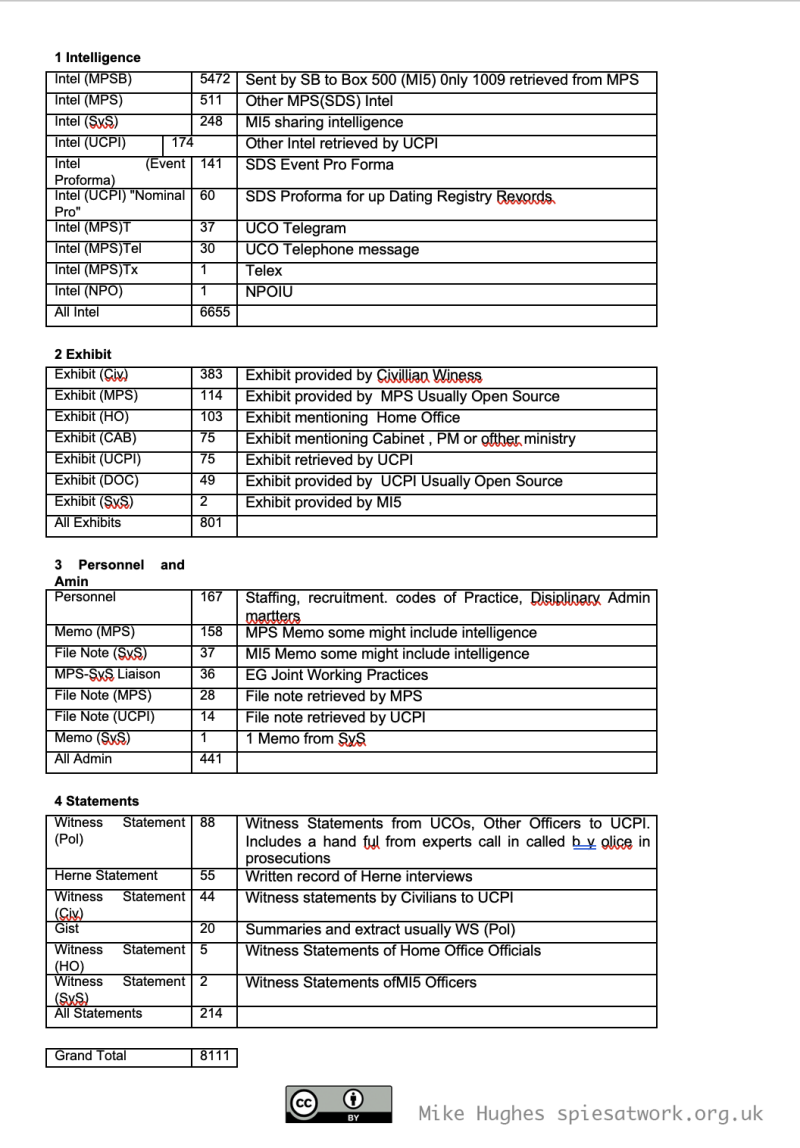
In my functional typology I have identified the following four overarching categories
1 Intelligence
2 Exhibit
3 Personnel and Admin
4 Statement
Below these there are sub:categories related to the content, purpose, orinating organisation and the retrieval of the evidence. These ar givenin the table at thend of the blog.
Data health warning and future developments
This would have been a mind boggling task if I had to open all the individual files. I therefore relied on the evidence description/name and clues in other fields. There will be some misplaced but it will be easier to find documents and of course within the “hugcats” you can also break the documents ino different, more “granular categories, When new data is added by the UCPI I will update it probably at the end of evidence taking sessions of the inquiry.
I think the reshaping of this emphasise that te published evidence of the inquiry is a historically important collection of documents not only about political policing and the secret state nut about the history of the extra-parliamentary left, civil and human rights and NVDA and non-criminal illegal demonstration.
The spread sheet of UCPI evidence from 28/2/26, with the new “hugcat” categories is available here:
CSV